
Social norms and participation of Indonesia’s women in agricultural decision-making
Sara Qanti (Faculty of Agriculture, Universitas Padjadjaran, Bandung, Indonesia) & Rico Ihle (Department of Social Sciences, Wageningen University, Wageningen, The Netherlands & Faculty of Agriculture, Universitas Padjadjaran, Bandung, Indonesia)
Promoting women’s empowerment and gender equality is crucial for achieving in particular the United Nations Sustainable Development Goal (SDG) 5. It implies that all countries worldwide have committed to achieve gender equality by empowering girls and women for having equal changes and conditions in societal development. Research in development economics found that when women actively participate in household decision-making within the family, it increases women’s access to resources and opportunities to enable them to have control over their lives and contribute fully to society (Alkire et al., 2013). Moreover, this also leads to positive outcomes for their families (i.e. better education and better nutrition in-take for their children, Acosta et al., 2019; Doss, 2013) and, thus, profits the entire society by advancing societal progress. In rural contexts, women’s involvement in household decision-making does not only promote empowerment but also results in improved productivity of the family farm and, thus, promotes local economic development across the regions of a country (Wardhana et al., 2017; 2020). Therefore, women’s empowerment also contributes to core global sustainability goals like ending poverty (SDG 1) and eliminating hunger (SDG 2).
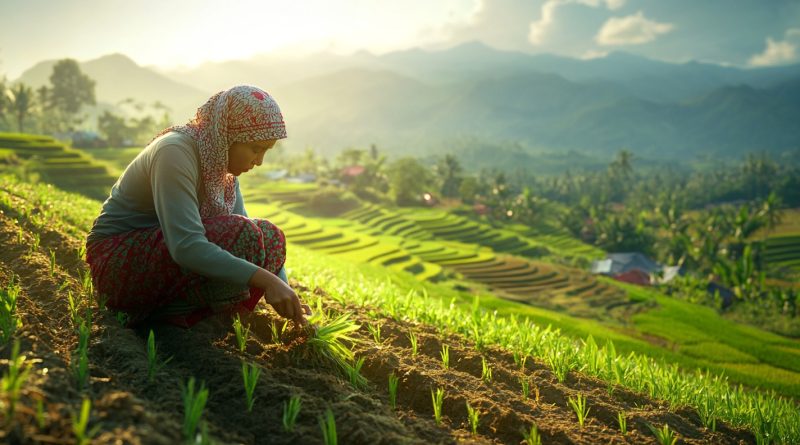
In Indonesia, where the livelihoods of around one third of the population are based on agricultural production of food and other renewable resources, women constitute about 30% of the workforce of that sector (ILO, 2019). In farm families, usually both men and women work together in semi-subsistence agricultural production on the family farm. Approximately, Indonesia’s 28.3 million rural women play vital roles in the country’s food production and, hence, also in the management of renewable natural resources on which Indonesia’s food security depends (FAO, 2019). They participate in all stages of agricultural production processes from planting and harvesting to post-harvest tasks such as grading, packing, and processing (FAO, 2019).
However, the shared expectations and the standards of behaviour within the Indonesian society – also called social norms – mostly believe that agriculture is a men’s business and as they are usually primary decision-makers in agriculture (Qanti et al., 2022). Despite women’s significant contributions to Indonesia’s strategic food production and food security, those social norms often limit women’s participation in decision-making both at home and in the community (Herartri, 2005; Puspitawati et al., 2018; Wijers, 2019). These barriers stem from persistent social norms that prescribe specific roles to men and women which influence how individuals think about themselves and others and which, hence, restrict their choices and abilities to fulfil their roles (UNDP, 2020; Nationen, 2014).
Universitas Padjadjaran in collaboration with the University of Adelaide conducted a study in 2019 which explored how Indonesian men and women perceive women’s participation in agricultural decision-making and how social norms, i.e. the general belief that agriculture is men’s business, affect these perceptions (Qanti et al., 2022). The research team interviewed husbands and wives of 438 agricultural families in the Upper Citarum Watershed, the biggest watershed of West Java, covering Bandung City and the surrounding regions of Bandung District, West Bandung District, Cimahi City, and Sumedang District. An increasing demand for agricultural products from the population centre of Bandung City, Indonesia’s fourth largest and ASEAN’s seventh largest urban agglomeration, led to rapid agricultural intensification in the watershed region, expanding horticultural crop cultivation, and greater diversification of both agricultural and non-agricultural livelihoods (Agaton et al., 2016; Mulyono, 2010). The husbands and wives were asked separately about their own and their spouse’s participation in agricultural decision-making, that is, all decisions related to production, marketing, investment, training needed for farm production, as well as the reasons behind these decisions to understand individuals’ beliefs about social norms.
The analysis of the beliefs of the almost 900 villagers of Qanti et al. (2022) reveal that, overall, women report less than equal participation in decision-making compared to their spouses. Women often point out that decisions are made in a certain way because that is the norm, i.e., the behavioural standard in their family or village. Conversely, men tend to report that their wives do not participate in decisions at all, implying that most decisions concerning farming processes are taken by men only as women are absent in those decision making processes. Men also tend to attribute decisions to whoever had better knowledge about the activity. For instance, men think that women do not participate in decisions about the application of plant-protecting agrochemicals because women do not have any knowledge about it. Both men and women report equal or higher participation of women compared to the roles of men in decision-making related to land transactions and credit requests for agricultural investments. This implies that rural women are aware of their say regarding important economic decisions of their families which produce large parts of the food they require on the family farm and also men acknowledge that role. Both genders report lower participation of women in decision-making regarding to farming technical aspects and attending trainings for agricultural production innovation.
The roles of Indonesian women in decisions concerning the marketing of the family farm’s agricultural outputs – so mainly what and how much to sell and for what price and to whom – still need to be clarified by future research. This also holds for clarifying the roles of women in decisions within their family which do not relate to the family farm’s agricultural production processes. Those decisions are very important to be well understood as they determine the food intake of the family members and are thus of crucial importance for improving nutritional statuses of children of especially poor families. Among those questions, it needs to be understood what influence women have to decide which food Indonesian rural families purchase additionally to their subsistence food production and what, how and how often certain types of food are prepared and served within the family. Additionally, the roles of women in the family decision-making concerning the storage of the self-grown food as well as the purchased food are important to be understood so that education and innovation initiatives of the government concerning food storage and preservation can be targeted to the correct group of persons.
The findings of the analysis of Qanti et al. (2022) suggest that social norms deeply ingrained in individual and community perspectives portray men as family heads and primary decision-makers for agricultural production decisions as men are seen by both genders as more knowledgeable about farming activities. These findings imply that the usual targeting focus of government programs and initiatives to men is reasonable to innovate and optimize the production processes of food and other renewable resources. The recognition of women’s crucial roles in credit and investment decisions, however, implies that government initiatives targeting this aspect should ensure that women have equal access to new knowledge and opportunities about financial resources and decision-making processes. Governmental organizations and NGOs are, thus, encouraged to design policies and programs that enhance women’s knowledge through training, particularly those closely related to opportunities in agricultural investments.
References
Agaton, M., Y. Setiawan, and H. Effendi. (2016). Land use/land cover change detection in an urban watershed: A case study of upper Citarum Watershed, West Java Province, Indonesia. Procedia Environmental Sciences 33: 654–660. https://doi.org/10.1016/j. proenv.2016.03.120
Acosta, M., M.V. Wessel, S.V. Bommel, E.L. Ampaire, J. Twyman, L. Jassogne, and P.H. Feindt. (2019). What does it mean to make a “joint” decision? Unpacking intrahousehold decision-making in agriculture: Implications for policy and practice. The Journal of Development Studies 56 (6): 1210–1229. https://doi.org/10.1080/00220388.2019.1650169
Alkire, S., Meinzen-Dick, R., Peterman, A., Quisumbing, A., Seymour, G., & Vaz, A. (2013). The women’s empowerment in agriculture index. World Development, 52, 71–91. https://doi.org/10. 1016/j.worlddev.2013.06.007
Doss, C. (2013). Intrahousehold bargaining and resource allocation in developing countries. The World Bank Research Observer 28 (1): 52–78. https://doi.org/10.1093/wbro/lkt001
FAO. (2019). Country gender assessment of agriculture and the rural sector in Indonesia. http://www.fao.org/3/ca6110en/ca6110en.pdf. Accessed 20 February 2021.
Herartri, R. (2005). Family planning decision-making at grass roots level: Case studies In West Java, Indonesia. PhD dissertation, School of Geography, Environment and Earth Sciences. Wellington, NZ: Victoria University of Wellington.
ILO. (2019). ILOSTAT database country profile. Accessed 15 June 2020. Jayachandran, S. 2020. Social norms as a barrier to women’s employment in developing countries. http://www.nber.org/papers/ w27449. Accessed 25 August 2020
Puspitawati, H., P. Faulkner, M. Sarma, and T. Herawati. (2018). Gender relations and subjective family well-being among farmer’s families: A comparative study between uplands and lowlands areas in West Java Province, Indonesia. Journal of Family Sciences 3 (1): 53–74. https://doi.org/10.29244/jfs.3.1.53-72
Qanti, S. R., Peralta, A., and Zeng, D. (2021). Social norms and perceptions drive women’s participation in agricultural decisions in West Java, Indonesia. Agriculture and Human Values, 1–18. https://doi.org/10.1007/s10460-021-10277-z
Mulyono, D. (2010). Konservasi lahan dan air di hulu Daerah Aliran Sungai (DAS) Citarum melalui pengembangan budidaya pertanian system agroforestry. Jurnal Rekayasa Lingkungan 6 (3): 253–262.
Nationen, V. (2014). Gender equality and sustainable development. World Survey on the Role of Women in Development 2014. New York, NY: United Nations.
UNDP. (2020). Tackling social norms: A game changer for gender inequalities. Transport and Trade Facilitation Series. UN. https://doi.org/10.18356/ff6018a7-en
Wardhana, D., Ihle, R. & W. Heijman. (2017). Agro-clusters and Rural Poverty: A Spatial Perspective for West Java. Bulletin of Indonesian Economic Studies 53: 161-186. www.doi.org/10.1080/00074918.2017.1298722
Wardhana, D., Ihle, R. & W. Heijman. (2020). Farmer Cooperation in Agro-clusters: Evidence from Indonesia. Agribusiness – An International Journal 36: 725-750. www.doi.org/10.1002/agr.21637
Wijers, G.D.M. (2019). Inequality regimes in Indonesian dairy cooperatives: Understanding institutional barriers to gender equality. Agriculture and Human Values 36: 167–181. https://doi.org/10. 1007/s10460-018-09908-9