
Colloquium for SDGs Interlinkages Study in Indonesia
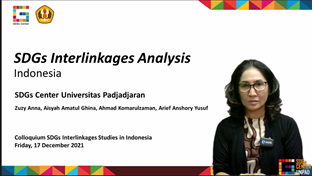
The Ministry of National Development Planning of the Republic of Indonesia held a Colloquium of the SDGs Interlinkage Study in Indonesia on December 17, 2021. This online event is the implementation of the SDGs Interlinkage Study Report in Indonesia which is a collaboration between the Ministry of National Development Planning/Bappenas and the German Government through the SDGs SSTC Project- GIZ Indonesia and SDGs Center Padjadjaran University.
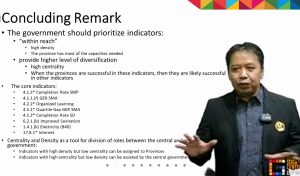
The presentation and discussion of the Study Results Report were presented by the Unpad SDG Center team, namely Prof. Zuzy Anna, Prof. Arief Anshory Yusuf, and Dr. Ahmad Komarulzaman. Prof. Arief explained how the flow of SDG interlinkages analysis consisted of (1) collecting historical data on SDGs indicators for all provinces in Indonesia; (2) measuring the performance of SDGs indicators based on comparative advantage (RCA); calculate (3) proximity, (4) centrality, (5) density, and (6) priority selection of SDGs indicators. Prof. Arief conveyed the results of an in-depth analysis of studies from four provinces, namely West Sumatra, East Nusa Tenggara, North Kalimantan, and Gorontalo. In his presentation, Prof. Arief said that the government prioritized indicators where the province had most of the required capacity (high density) and indicators with high centrality that showed the province was successful in this indicator, then the province had a better chance of achieving other indicators.
On this occasion, after the presentation from the SDG Center Unpad, there were several presentations from Dr. Venkatachalam Anbumozhi from the Economic research institute for ASEAN and East Asia (ERIA). He comments on what has been done in this study. He explained that the narrative SDGs were clearly linked to the Indonesian context to determine priorities. He provides an overview of how the position of linkage in the implementation of the SDGs is to determine policies and decisions and budget allocations.
The second comment was delivered by Dr. Mustafa Moinuddin as Deputy Director of the Integrated Sustainability Center Institute for Global Environmental Strategies (IGES). He explained that it would be good if the study used compared data from 34 provinces. Dr. Mustafa explained the need for studies involving Goal 13, Goal 14, and Goal 15 which are important in environmental issues. Next Dr. Mustafa emphasized the importance of understanding the local context.
After the presentation of the Study Report and the response from Dr. Venkatachalam and Dr. Mustafa, a question and answer session was held with participants from both the government and academic sectors. In the last session, Mrs. Vivi Yulaswati as Expert Staff to the Minister for Social Affairs and Poverty Reduction, as Head of the National Secretariat of TPB/SDGs at the Ministry of National Development Planning/Bappenas. provide closing notes such as The results of a study of 4 provinces show that the analysis used can provide an overview of the priority indicators of SDGs implementation by policymakers (Government and Local Government), However, the quantitative statistical analysis still requires interpretation by experts or groups of experts in certain sectors. The challenges in this study include the availability of time series data around 10 years, especially on data related to indicators on environmental-related Goals.
Based on the previous discussion, the study results can even be supported by the Regional Research Agency (BRIDA) so that it can be developed at the regional to district/city levels. Various questions and inputs in this discussion have provided the improvement of SDGs Interlinkages studies in the future and there is a need for active participation and synergy of various parties to support this.